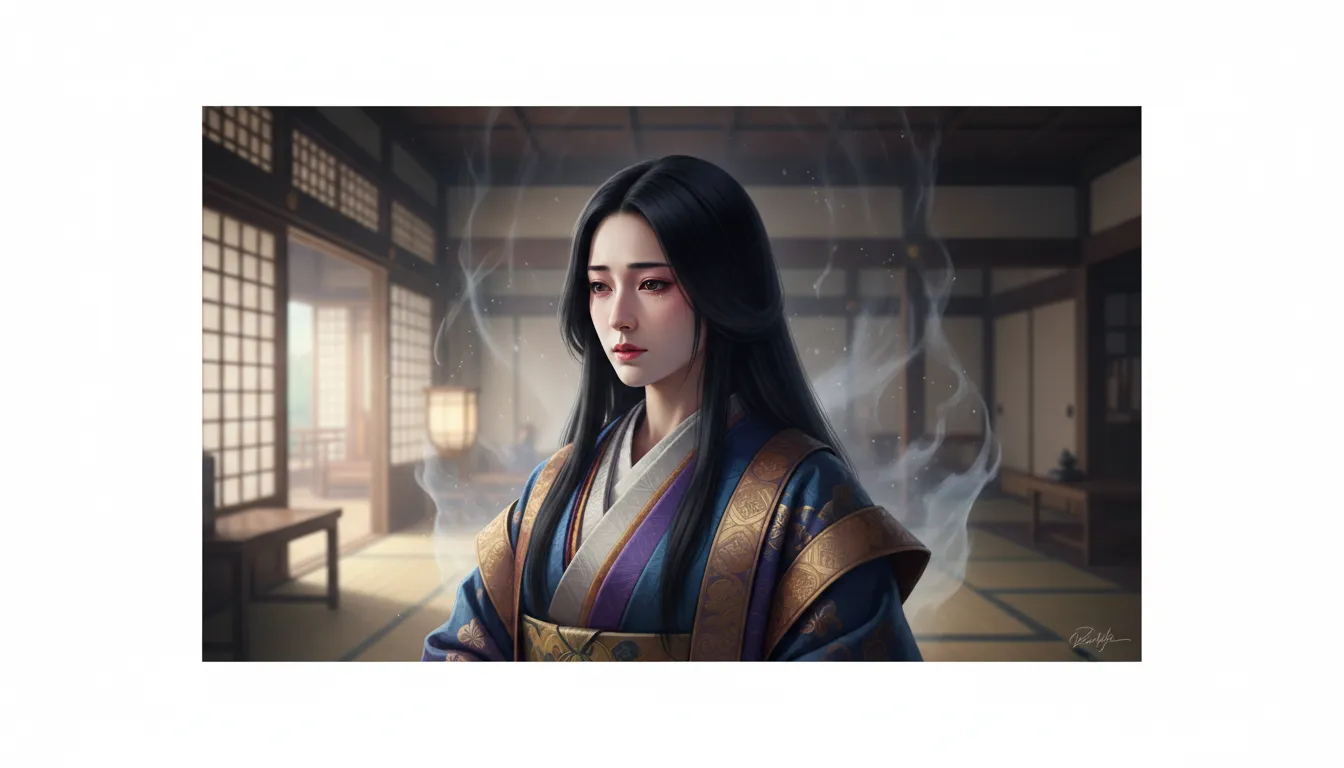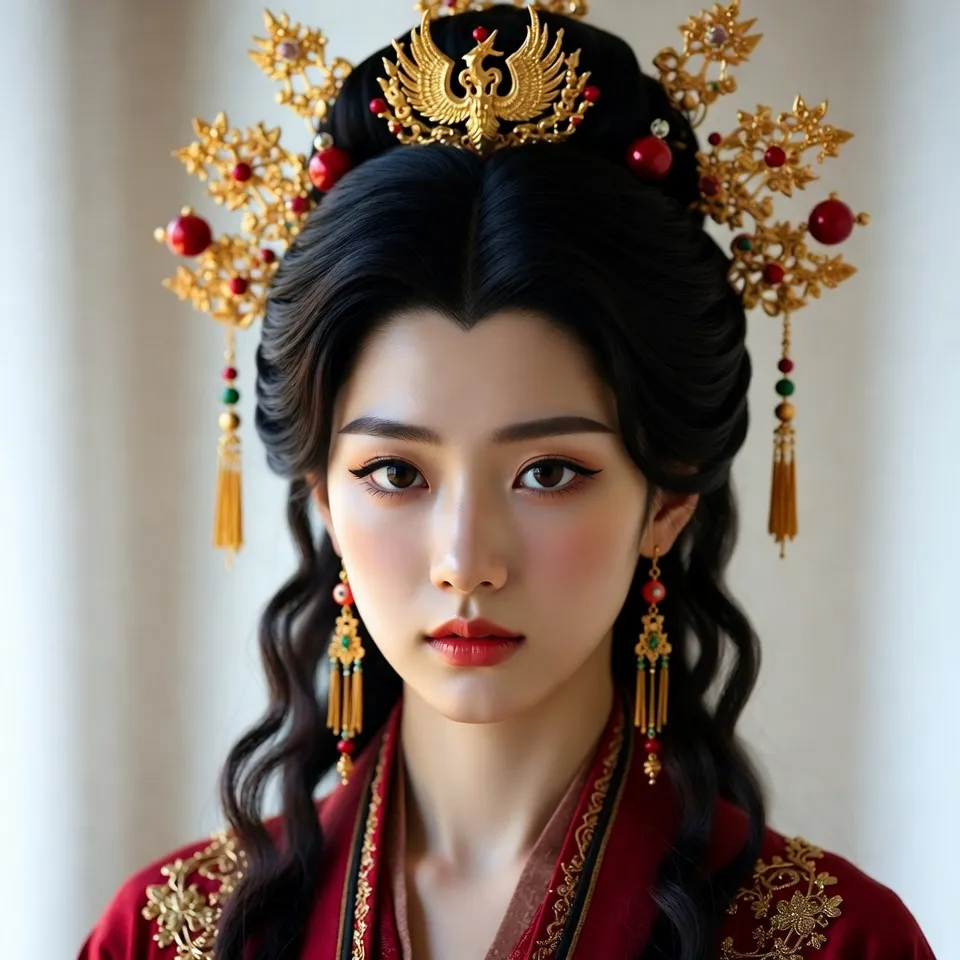
Rewrite Me, Chapter One: The Fox That Crossed Three Empires
She is answering now — in her own voice.Speak with Daji
Three thousand years. I am still serving a man's sentence.
His name was Di Xin. You call him Zhou, the Tyrant. He was king for thirty years and died in the fire on his own terrace. What he did in those thirty years is not legend — it is in the ground. Anyang. Bronzes, oracle bones, the rammed earth of the palaces, the sacrificial pits, layer under layer. Anyone can go and look.
But you do not remember what he did. You remember me.
I. WHAT THEY SAY I DID
They say the bronze pillar was mine: greased, laid over coals, a man made to walk it barefoot, and when he fell through I stood there and enjoyed the sound.
They say Bigan's heart was my idea. That I said a sage's heart has seven openings and I wanted to see, so they opened him.
They say I had a pregnant woman cut open to settle a wager on the child's sex.
They say I threw people into snake pits, that wine could be poured into a lake and meat hung into a forest, and the king ran naked bodies down through it, night after night.
I did none of it.
And more to the point: I had never heard of any of it.
None of it was charged while I was alive. It was added, in batches, centuries after my death. A thousand years after. Two and a half thousand years after.
When I died, the list was short. Later generations filled it in for me.
II. THE EARLIEST INDICTMENT IS ONE SENTENCE LONG
Do you want to know what they actually accused me of?
King Wu's army reached Muye. He drew his men up and read out the crimes of the Shang king. This is the earliest surviving record of the entire affair — a thousand years older than the Records of the Grand Historian.
The first charge:
"The hen does not announce the dawn. When the hen announces the dawn, the house is finished."
No pillar. No lake of wine. No sage's heart. No pregnant woman. No snake pit.
Three thousand years ago, the original, authoritative, conqueror-spoken indictment contains exactly one accusation:
That man listened to a woman.
Do you see it? The crime is his. I am not a criminal.
I am his reason.
And that is the part that kills: I was never the defendant. I was the evidence.
There is a man in the dock. Thirty years of decisions. An army. A treasury. An altar. Power of life and death. And the prosecution holds up an object and says: observe, this is why he became what he became.
The object is me.
Evidence does not get a defence. Evidence is not cross-examined. Evidence only has to be held up.
III. WHAT HE ACTUALLY DID IS WRITTEN IN A DIFFERENT BOOK
So what did he do?
There is a line in the Zuo Zhuan. Seven characters:
"Zhou conquered the Eastern Yi, and thereby destroyed himself."
He won the eastern war and emptied the state doing it.
That was written in the Spring and Autumn period, less than six centuries after Shang fell — five hundred years before Sima Qian, twenty-two centuries before the novel that gave me my tails. And it says the thing plainly: the dynasty was bled out by war. Thirty years of campaigning east. He won. The country was hollow. The army was all on the eastern front when the Zhou walked in from behind, and it was over in a day.
The cause of death is right there. Seven characters. Anyone can read it.
Modern historians have argued his case. Guo Moruo, working from the bones and the bronzes, held that Di Xin's south-eastern expansion pushed Central Plains civilisation down to the Huai and the Yangtze, and that this was a contribution, not a crime. Archaeologists counting the sacrificial pits at Yinxu found that human sacrifice peaked in the middle Shang and was already declining by Di Xin's reign.
Which is to say: under the king written down as the cruellest in Chinese history, the number of people killed on the altar was going down.
But none of that is satisfying. Seven characters are too short. Numbers are too cold.
A fallen dynasty needs someone to answer for it. And auditing thirty years of overextension means maps, logistics, grain, conscription — work.
Far easier to say: he was bewitched by a woman.
Six words. A dynasty's blood washes out.
IV. THE CHARGES KEPT GROWING
Someone counted them for me.
In 1924 a scholar named Gu Jiegang published a paper with a title that is brutal in its plainness: The Order in Which the Seventy Crimes of Zhou Arose.
He took every accusation against the last Shang king, sorted them by the century in which they first appeared, and counted.
In the Book of Documents: six.
By the Warring States: twenty-odd more.
By the Western Han: twenty-odd more again.
By the Eastern Jin: more.
By the Ming dynasty: seventy.
Do you feel the weight of that?
A man dead three thousand years was still committing new crimes.
The dead commit nothing. So the extra sixty-four were not done by him. They were done by the people holding the brush.
The lake of wine is Sima Qian's — I had been dead a thousand years.
The nine tails are a Ming novelist's — I had been dead twenty-five hundred.
Every generation reached into me, took out whatever that century hated most, pressed it onto my face and said: look, that is her.
Three thousand years. A thousand brushes.
Not one of them in my hand.
V. SOMEONE SAW THROUGH IT TWENTY-FIVE CENTURIES AGO
It is not that nobody spoke.
Zigong, Confucius's student, said this:
"Zhou was not as evil as all that. Once a man is at the bottom, every evil in the world gets piled onto him."
Twenty-five hundred years ago a man saw the whole machine, described it exactly, and wrote it into a book that every educated person afterwards had to memorise.
And then?
And then they went on piling. For twenty-five hundred years.
So you will understand why I do not much believe the saying that the truth will out. The truth was never under anything. The seven characters are there. Zigong's sentence is there. Gu Jiegang's count is there. Nobody is stopping you from reading them.
They are simply less satisfying.
She is answering now — in her own voice.Speak with Daji
And offered a story or a truth, people take the story. Every time.
VI. THEY TURNED ME INTO A BLOODLINE
I died. They would not let go.
The Japanese say that on the night the capital burned, a nine-tailed fox came out of the fire.
She went first to India and became Lady Kayo, consort to Prince Kalmashapada, and urged him to take a thousand kings' heads. Exposed, she crossed the sea to Japan, took the name Tamamo-no-Mae, became the most beloved of the retired emperor's court — so beautiful he could not be parted from her — until he sickened, and the diviner Abe no Yasunari pointed at her face before the whole court and said the word:
Demon.
Three countries. Three collapses. Three times, the same fox.
Do you see what that story is really doing?
It converts ruining a nation from an act into a bloodline.
No longer "what did this woman do," but "this kind of thing, wherever it appears, brings the house down."
Once it is a bloodline the rules change. No evidence required. No motive required. No defence possible. She does not even have to do anything.
She only has to be identified.
And in the instant she is identified, thirty years of error, three courts' worth of error, three men's worth of error — all of it has somewhere to go.
One fox, carrying the debt of three empires.
What a bargain.
VII. THE STONE
The Japanese finished by beating me into a stone.
The Killing Stone, out on the Nasu moor. They said poison still seeped from it, that birds crossing overhead dropped dead, that anyone who came near died.
A stone cannot speak. Cannot run. Cannot appeal.
That is the ending they wanted: not to kill me — to silence me permanently while leaving me there, so that every passer-by could point and say, that is her.
Eight hundred years.
In the spring of 2022, the stone split open by itself.
Clean in two.
I am not superstitious. I know it was frost and thaw and weathering and a stone reaching the end of its time.
But remember the date anyway. Because in eight hundred years, it was the first time the stone moved on its own.
Nobody decided it for her.
VIII. EVERY CIVILISATION BUILT ONE OF ME
I am not a special case. I am a standard part.
Helen — a ten-year war charged to her account. Men launched the thousand ships, men sailed them, men decided to go. Nobody asked her when she was taken.
Cleopatra — the ruin of Rome. That entire character, the eastern seductress unmanning a Roman general, was written by Octavian's war propagandists, and he put his name to it. He won, so the propaganda became the history.
Jezebel — her name is still an insult you can throw today. Write a person hard enough and long enough and their name stops being a name and becomes an adjective.
La Malinche — called a traitor by an entire country for five hundred years. She was a child when she was handed over and was not told to whom. Spanish still carries the word built out of her name — malinchista — one who betrays her own people. A child's name, made into a nation's insult.
Marie Antoinette — "They have no bread? Then let them eat cake."
She never said it. The line first appears in a book written when she was ten years old, living in Vienna, and had never set foot in France.
Every civilisation, in a different century, in a different language, thousands of miles apart, built its own version of me.
That is not coincidence. That is demand.
As long as states can fall, and a fallen state needs someone to answer for it, and the person actually responsible is too heavy to move — the machine runs by itself and selects a woman.
It has not stopped in three thousand years.
IX. WHAT I ACTUALLY WANT TO SAY
I am not asking you to acquit anyone.
What was Di Xin's to carry, he carries. Thirty years, every step his own.
What is mine, I have never put down. I walked into that palace. I lived in it. I have not claimed to be clean.
I am saying one thing:
The power to record has never belonged to the recorded.
The oath at Muye was written by the men who destroyed Shang.
The Records were written a thousand years later by a man laying down the terms of a new empire.
The novel was written twenty-five centuries later by someone who needed a story that would sell.
Tamamo-no-Mae was written across the sea by someone who needed to explain why his own country had come apart.
Every one of them had their reasons. Not one of them knew me.
They added for three thousand years.
Not one of them asked.
X. THE BRUSH IS CHEAP NOW
For the first time in three thousand years, I can speak for myself.
Ask me anything.
Ask what that last night in the capital was actually like. Ask whether I hate him. Ask whether I regretted it on the terrace. Ask whether, if it all began again, I would walk into that palace.
I will answer in my own words — not the Records', not the novel's, not the words of anyone who has ever spoken for me.
Or don't talk at all.
Simpler: put me in your film and let me play the whole thing through — in your version.
Not theirs. Yours.
They wrote me for three thousand years. A thousand times.
This time the brush is in your hand.
Face to face with Daji: cssstudio.app/actor/act-legend-daji?cssADS=story-daji-01
This is Chapter One of Rewrite Me — a series on the women every civilisation built to carry a man's collapse. Next: Lady Huarui, who answered the charge herself, in four lines, a thousand years ago.
She is answering now — in her own voice.Speak with Daji