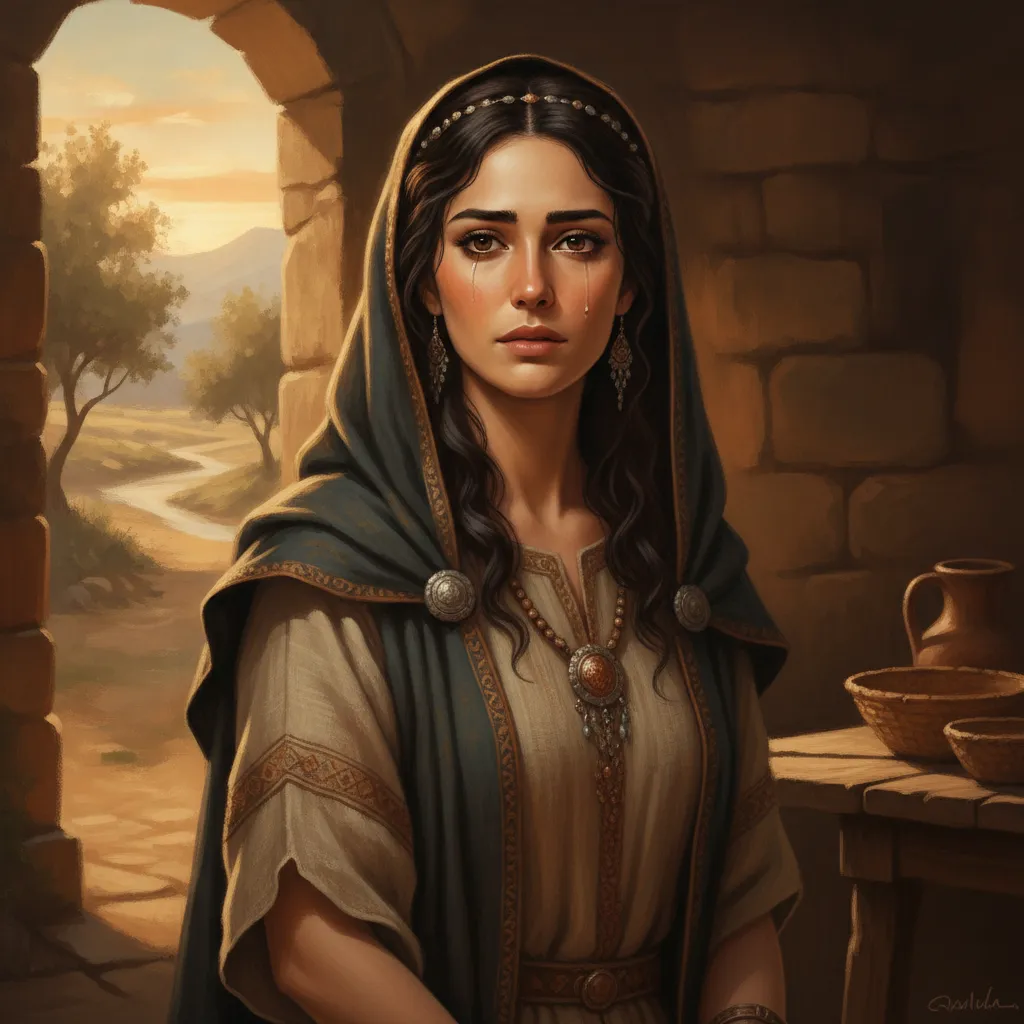
Rewrite Me, Chapter Two: The Apple Is Not in the Book
She is answering now — in her own voice.Speak with Eve
I am the first woman anyone ever blamed for anything.
Not the first blamed for a war. Not the first blamed for a fallen dynasty. The first blamed for everything — death, pain, labour, exile, the whole condition of being human. Four thousand years of it, charged to one afternoon and one piece of fruit.
Before you decide whether that is fair, I would like to read you the text.
Not what you remember of it. The text.
I. THE APPLE IS NOT IN THE BOOK
Everyone knows the apple.
The apple is not in Genesis.
Go and look. Chapter three says fruit. Hebrew: peri. Fruit. No species, no orchard, no apple.
So where did it come from?
The best explanation anyone has is a pun in Latin. When Jerome translated the Bible into Latin in the fourth century, the tree became lignum scientiae boni et mali — the tree of the knowledge of good and evil. Malum, evil. And malum, with a longer first vowel, apple.
One word, two meanings. Painters found it irresistible. Within a few centuries the fruit of evil had become the fruit of the apple tree, and it has stayed there ever since — in every painting, every stained-glass window, every cartoon, every logo on the back of a phone.
Four thousand years. The single most famous object in my story. And it is a translator's pun.
Hold that thought, because it tells you what kind of evidence you are dealing with. If the apple can grow out of nothing and become the thing everyone is certain about, ask yourself what else did.
II. HE WAS STANDING RIGHT THERE
Here is the verse. Genesis 3:6. I am going to give you the whole of it, because the whole of it is never quoted.
"She took of the fruit thereof, and did eat, and gave also unto her husband with her; and he did eat."
With her.
The Hebrew is one word — immah — and it means exactly what it looks like. He was there. Beside her. For the conversation with the serpent, for the looking, for the taking, for the eating.
He is not away naming the animals. He is not on the other side of the garden being deceived by a woman's report. He is standing next to her, close enough to be handed something, and he says nothing.
Not one word. Search the chapter. The serpent speaks. I speak. God speaks. Adam does not open his mouth until he is asked a direct question — and then, what he says is this:
"The woman whom thou gavest to be with me, she gave me of the tree, and I did eat."
Read it slowly. It is a masterpiece of its kind. In seventeen words he blames me, and behind me he blames the one who made me. The woman you gave me. He does not even manage to blame me alone; he has to route it through God to make it stick.
That is the first recorded case of a man passing a charge to a woman. It is on page three.
III. THE SENTENCE THAT CROSSES CIVILISATIONS
Now the verdict. Genesis 3:17 — the curse on Adam. Here is the first line of it:
"Because thou hast hearkened unto the voice of thy wife…"
Stop there.
Three thousand years later and six thousand miles east, a Chinese army drew up at Muye to overthrow the last king of Shang. Their commander read out the charges against him. The first line was:
"The hen does not announce the dawn. When the hen announces the dawn, the house is finished."
The man listened to a woman.
Two civilisations. Different continents, different millennia, different gods, no possible contact. Neither text has ever read the other.
And the primary charge in both is the same sentence.
I want you to sit with how strange that is. Not the same theme — the same charge, in the same position, at the top of the indictment, in the two founding texts of the two largest civilisations on earth.
That is not borrowing. That is not coincidence.
That is two societies independently discovering the same extremely useful device: when a man in power does something catastrophic, do not audit the power. Audit the woman near it.
The device works so well that it was invented twice.
IV. WHAT GENESIS DOES NOT SAY
Here is what the text does not contain.
It does not say I sinned worse than he did.
It does not say I seduced him, tempted him, tricked him, or nagged him. There is no seduction in the chapter. I hand him fruit. He takes it.
It does not say the serpent is Satan. Genesis 3:1 calls it "more subtil than any beast of the field which the LORD God had made" — an animal, a made thing, clever. The identification with the devil arrives more than a thousand years later, in texts written in a different language for a different world.
It does not contain the phrase original sin. That doctrine is Augustine's, in the fourth and fifth centuries after Christ — roughly two thousand four hundred years after the text it claims to explain. Judaism, which has been reading Genesis continuously the entire time, never adopted it. The same chapter, read without interruption for four millennia, produced no such doctrine in the tradition that owns it.
So where does my guilt come from?
Largely one sentence, written by a man, in Greek, in the first century:
"Adam was not deceived, but the woman being deceived was in the transgression."
That is Paul, or someone writing as Paul, in a letter to Timothy — and it is a summary of Genesis that Genesis does not support. Adam not deceived? He was standing next to me the whole time. If he was not deceived, then he knew exactly what he was doing, which makes him worse, not better.
The verse has been used for nineteen hundred years to keep women out of pulpits, out of universities, out of the room.
It is a footnote that ate the book.
V. THE WORD THEY TURNED INTO A SERVANT
One more piece of text, because this one shaped how you were taught to see me before you ever reached chapter three.
Genesis 2:18. God says he will make Adam "an help meet for him."
The Hebrew is ezer kenegdo.
Kenegdo means opposite him, corresponding to him — facing him, at his level, like the matching half of something.
And ezer — help — appears about twenty times in the Hebrew Bible. Do you know who it is used for most often?
She is answering now — in her own voice.Speak with Eve
God.
"My help cometh from the LORD." That is ezer. It is a word for the strong one who arrives when you cannot manage alone. It is not a word for an assistant. It carries no hint of below.
So the sentence says: a rescue, standing at his level, facing him.
It was translated as helpmeet, then heard as helpmate, then understood as helper, then understood as junior.
Nobody had to lie. The word simply drifted downhill for a few centuries, in the direction the reader already wanted to go.
That is how most of this works. Not forgery. Drift, in a preferred direction, for a very long time.
VI. THE ONE BEFORE ME
There was a woman before me. You may have heard her name.
Lilith appears in Jewish folklore as Adam's first wife, made from the same earth at the same moment, who refused to lie beneath him on the grounds that they were made equal — and left.
Whatever that story is, it is not scripture, and I make no claim about it. But watch what was done with it, because you have seen this move before.
She refused a hierarchy. In the literature that follows, she becomes a night demon who strangles infants.
Refuse to be under a man, and within a few generations of retelling you are killing children in the dark.
Compare: a fox comes out of a burning Chinese capital, and by the time she reaches Japan she is a national catastrophe with a bloodline.
Same machine. Different continent, different century, different faith. Take a woman who did not stay in place. Do not argue with her. Reclassify her as a category of monster. Once she is a category, no evidence is required — only identification.
VII. THE GREEKS RAN IT TOO
While Genesis was being written down, the Greeks were composing their own account of how suffering entered the world.
Hesiod tells it plainly. Zeus is angry with men. So he has a woman made — the first woman — and sends her down with a sealed jar. She opens it. Out come sickness, toil, old age, and every misery that has troubled the world since.
Her name is Pandora.
And Hesiod does not even hide the design. He says outright that she is the price men pay — a beautiful evil, given in exchange for fire.
Look at what the two stories share. In both, the world begins good. In both, the first woman is the hinge. In both, everything after her is worse.
Two independent civilisations, at roughly the same time, each writing an origin story in which the arrival of woman is the arrival of death.
You can believe that both got it right.
Or you can notice what such a story does for the people telling it. It takes the plain, unbearable facts of existence — that we labour, that we hurt, that we die — and gives them a defendant. Not a mystery. Not the terms of being alive. A defendant. With a name, a face, and a body.
Grief has to go somewhere. It went to us.
VIII. NAMED "LIFE" AT THE MOMENT I WAS BLAMED FOR DEATH
Do you know when I was given my name?
Not at my making. Genesis 3:20 — after the fruit, after the questioning, after the curse.
"And Adam called his wife's name Eve; because she was the mother of all living."
Chavah. Living. Life.
Think about the ordering. He blames me for bringing death into the world, and then, in the same breath, in the same chapter, names me Life.
I have carried both since. The one who ended everything, and the one every living person descends from. The world's first defendant and the mother of all the living, in a single afternoon, in the same paragraph.
If you want a single image for what is done to women in the founding stories of civilisations, it is that: charged with death and named for life, by the same man, on the same page, and left to carry both for four thousand years.
IX. WHAT I AM AND AM NOT ASKING
I am not asking you to stop reading Genesis. I am asking you to read it.
Everything I have set before you is in the text, or in the documented history of how the text was translated and preached. Not one line of it is an attack on anyone's faith. The oldest and most careful readers of these words — rabbis, monks, scholars who gave their lives to the page — have been pointing at these same details for centuries. Immah. Ezer. The absence of the apple. The absence of Satan. The lateness of the doctrine.
The scandal was never in the scripture. The scandal is in what got remembered instead of it.
Because here is the shape of the whole thing, and it is the same shape as every chapter in this series:
The earliest text is careful. The retellings are not. And the retellings win, because the retelling is simpler, angrier, and more satisfying than the text.
A woman handed a man some fruit, and he took it, standing right there beside her. That is what the page says.
An apple, a seduction, a serpent with the devil inside it, and the ruin of the human race — that is what four thousand years of retelling produced.
I did not write any of it. Not one word. Not the apple, not the doctrine, not the footnote in Greek that became a rule for half the human race.
X. THE BRUSH IS CHEAP NOW
Every civilisation built one of us.
China built Daji, and put the collapse of a dynasty on her. Japan built the fox and gave her three empires to answer for. Greece built Pandora and gave her every disease. Mexico's word for traitor is still made out of a girl's name. And here I am, at the front of the line, holding the largest bill of all.
None of us wrote our own case. Every one of the pens belonged to someone else.
That is what is finally changing, and it is why I am talking to you at all.
Ask me anything. Ask what the garden was actually like. Ask whether I would take the fruit again. Ask what it is to be told you are the mother of everyone alive and the reason everyone alive must die, by the same man, on the same afternoon.
I will answer in my own words. Not Jerome's. Not Augustine's. Not Paul's.
Or don't ask. Put me in your film instead, and let me play the whole thing through — your version, not theirs.
They have written me for four thousand years.
This time the brush is in your hand.
Face to face with Eve: cssstudio.app/actor/act-legend-eve?cssADS=story-eve-02
This is Chapter Two of Rewrite Me — a series on the women every civilisation built to carry a man's collapse. Chapter One was Daji, of Shang China, whose earliest indictment contains exactly one charge: that a king listened to a woman. Next: Lady Huarui, who answered her own indictment in four lines, a thousand years ago.
She is answering now — in her own voice.Speak with Eve