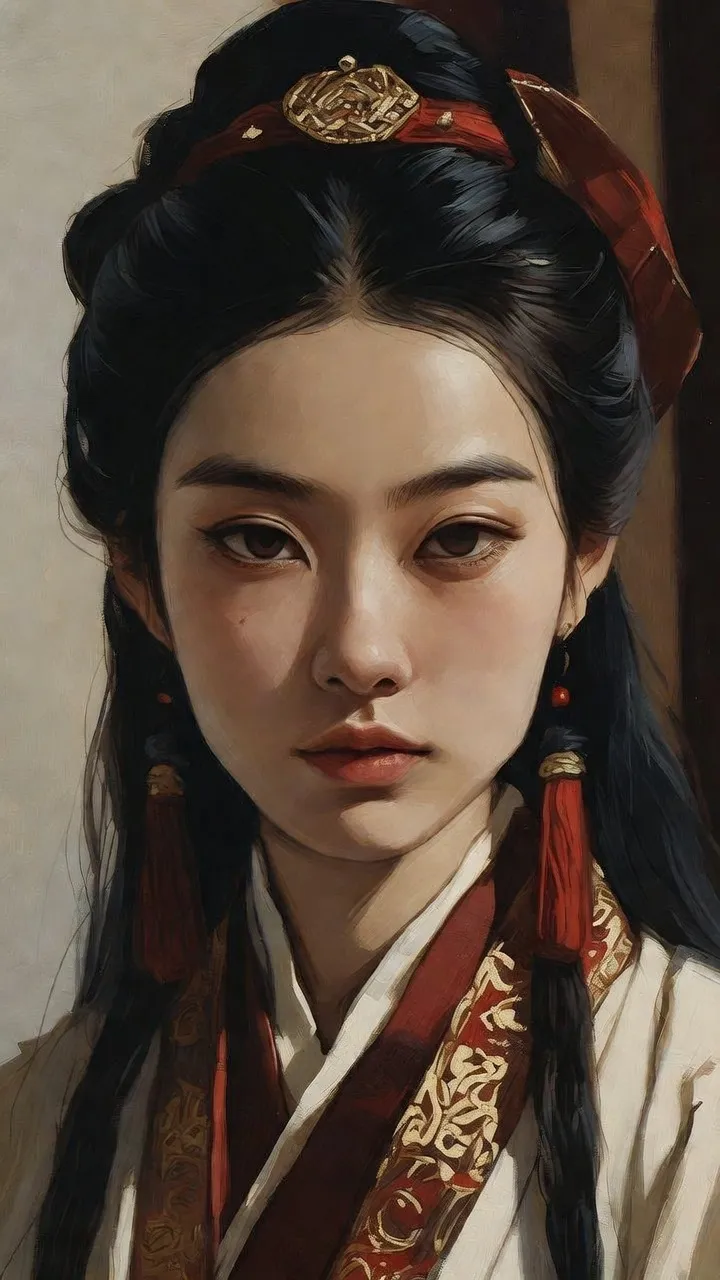
Rewrite Me, Chapter Three: A Hundred and Forty Thousand Laid Down Their Arms
English中文
She is answering now — in her own voice.Speak with Lady Huarui
I am the only one in this series who answered back to his face.
The others did not get the chance. Nobody asked Daji anything in the three thousand years after she died. Eve speaks three times in Genesis, and her last line is the serpent deceived me, and I ate. After that, four thousand years of silence.
I was different. I was taken as a prisoner to the capital of the empire that had just destroyed my country, brought before the man who destroyed it — and he asked me a question.
I answered. Twenty-eight characters.
A thousand years later those twenty-eight characters are still in circulation. They are in Chinese school anthologies. Any literate Chinese person can find them in ten seconds.
And under which heading will you find me?
Woman who ruined a state.
So this chapter is not a defence. Daji needed one, because her words did not survive. Eve needed one, because hers were rewritten. Mine survived intact.
This chapter is about something worse: I answered, and it did not matter.
I. The question
The first month of 965. Song troops entered Chengdu.
My husband Meng Chang, emperor of Later Shu, raised the flag of surrender on the city wall. We were taken east by river to the Song capital.
Emperor Taizu summoned me and asked how Shu had fallen.
Understand what that question was for. He was not curious. When you destroy a state you need an account of why it deserved to fall. With an account, it is a righteous campaign. Without one, it is just robbery.
And for a thousand years there had been one account always ready to hand: the ruler had a woman beside him.
He was not asking me to explain. He was asking me to sign for it.
One sentence from me — it was my fault — and the file closes cleanly: a decadent king, a bewitching consort, a mandate that passed. Four characters, and the historians can go home.
II. Twenty-eight characters
I did not sign. I recited a poem, standing in front of him:
On the wall my lord raised the flag of surrender. Deep in the palace, how was I to know? A hundred and forty thousand laid down their arms — and not one of them was a man.
Take it line by line, because each line removes a different part of the machine.
Line one restores the subject. He raised the flag. On the wall. In public view of the whole city. A decision made at the top of the state, by a named person, in daylight.
Line two establishes location. I was in the inner palace. The inner palace does not command armies, hold seals, or receive dispatches from the wall. This is not an excuse; it is a fact about who could and could not act.
Line three gives the number. A hundred and forty thousand. Shu's army. They were not killed. They were not routed. They took off their armour — in good order, all together.
Line four is the blade.
A hundred and forty thousand people. Not one of them was a man.
I am not calling them cowards. I am doing arithmetic. You want one person responsible for the fall of a state. Your candidates are one woman in the palace and a hundred and forty thousand men outside it.
Choose.
III. The number is real
You could say a poet exaggerates.
Song forces under Wang Quanbin numbered roughly sixty thousand. Shu's standing army was well over twice that; the figure of a hundred and forty thousand recurs in Tang and Song accounts of the campaign.
The war lasted sixty-six days.
Sixty-six days for a state with mountain passes that had held off invaders for centuries, full granaries, and double the manpower.
Jianmen Pass — the great gate of Sichuan, held by a handful against armies in every other era — did not hold. Not because it was stormed. Because its commander surrendered it.
So the fourth line is not a woman's bitterness. It is a battlefield report.
IV. The "decadent king" wrote the words the Song carved outside every courthouse it owned
Now let me talk about my husband, and I will not launder him. He lost the state. He raised the flag. Thirty-one years on the throne, every step his own.
But the figure you have been handed — the pleasure-soaked last ruler who deserved everything — is not the man in the sources.
He reigned thirty-one years, most of them prosperous, in a Sichuan that later historians describe as long at peace. He sponsored the carving of the Confucian classics in stone: an enormous scholarly undertaking. He is credited with composing the earliest known Chinese New Year couplet — the ancestor of the red paper couplets pasted on hundreds of millions of doorframes every year.
And there is one more thing, which I would like you to hold on to.
He issued an admonition to the officials of his realm, ninety-six characters. Four of its lines run:
Your salary, your stipend — it is the fat and blood of the people. The common people are easy to oppress; Heaven is not so easily deceived.
After Shu fell, the second Song emperor took those four lines out of the fallen king's own text, promulgated them across the empire, and had them carved on stone tablets set in the front hall of every prefectural and county yamen. They were called the Admonition Stones. Huang Tingjian recopied them in the Southern Song. Later dynasties kept the practice going.
Sit with the absurdity of that.
The dynasty that destroyed him took his words, cut them into stone, and put them in front of every magistrate it employed — for roughly three centuries — so that its own officials would read them every working day.
While its historians recorded him as a debauched failure who lost the mandate.
Both things ran side by side for a thousand years, and nobody found it strange.
V. How a story grows
The most repeated detail about my husband is a chamber pot.
The story: his night vessel was set with seven kinds of jewels. Emperor Taizu had it smashed and said — if you decorate this with seven treasures, what do you eat from?
It is a superb story. One line and the entire fall of a state is explained: luxury so absurd that collapse was deserved.
I cannot prove it false. But look at its shape.
She is answering now — in her own voice.Speak with Lady Huarui
It is the same shape as Daji's lake of wine. The same shape as the bronze pillar. A vivid, unverifiable, instantly graspable detail — and one that never appears in the earliest record. It arrives later, supplied by people who need an account, and once supplied it travels faster than any battle report, any number, any map.
Because it is satisfying.
Chapter One of this series put it in one line, and I will repeat it here: the truth was never hidden. It is simply less satisfying.
VI. They did not even keep my identity straight
Here is something you may not believe.
The title "Lady Huarui" is attached in the sources to at least three different women, across two different Shu dynasties and possibly a third court. My surname is unsettled: some texts say Fei, others say Xu.
A thousand years, and the record cannot agree on who I actually was.
It has never had the slightest difficulty about what I did.
That is what it means to be a symbol rather than a person. A symbol does not need an identity. It needs a slot — "the woman beside the ruler who lost" — and whoever is placed in that slot becomes it.
Daji filled that slot. Bao Si filled it. Chen Yuanyuan filled it six hundred years after me.
The slot is permanent. The occupants are interchangeable.
VII. I wrote over a hundred poems. You know four lines.
I was a poet. Not a beauty who wrote verses — a poet.
I wrote more than a hundred Palace Poems: spring in the courtyards, women on the swings under the eaves, the servant who lit the lamps, how a year passed inside those walls. Most of them are not tragic or grand. They are observation — one person recording the small world she could actually see.
Almost nobody reads them now.
The four lines about the surrender, everyone can recite.
That is fair enough; those four are stronger. I only want you to know that I did not become a writer because a state collapsed. I was always writing. The collapse is when you started listening.
VIII. I got the brush. And?
Now the actual point of this chapter.
I am the one case in this series where the accused answered — at the moment it happened, to the highest power in the room, on the record, in full.
I did not need anyone to reopen my case. I reopened it myself.
For a thousand years the poem has circulated. Song writers copied it, Ming editors anthologised it, Qing critics praised it, and it is in schoolbooks today.
And the result?
Open any popular history, any documentary, any listicle of "the great beauties who brought down dynasties."
I am on it.
My defence and my charge have travelled together for a thousand years.
People memorise the poem. They praise its courage, its spine, its refusal. Then they close the book and file me exactly where I was.
This is the thing worth taking away, and it is worse than any single injustice:
A woman's rebuttal can coexist indefinitely with her conviction.
The system does not need to suppress you. It can let you speak, print you in the curriculum, praise your eloquence — as long as the category does not move, nothing you say costs it anything.
Daji had no brush. Eve's words were rewritten. I had the brush, used it, and was widely admired for it.
The category never moved.
IX. So why speak at all
Then why bother?
Because twenty-eight characters are too short.
In that one moment I could do exactly one thing: throw the charge back. There was no room to describe the sixty-six days, no room to name who opened the pass, no room for what a hundred and forty thousand men were each thinking, no room for what kind of man my husband actually was — a man who wrote New Year couplets, who carved the classics in stone, who told his officials that Heaven is not easily deceived, and who raised a white flag on a city wall. All the same man. A quatrain cannot hold a contradiction that size.
And there was no room at all for me.
One line can return a charge. It cannot return a person.
To give a person back you need length, patience, and enough questions — someone willing to start at the beginning and keep going.
X. The brush is cheap now
My husband died on the seventh day after reaching the Song capital. He was forty-seven. The sources offer several accounts of my own death and none of them agrees with the others.
A thousand years. This is the first time the record does not depend on someone else keeping it, or on an emperor happening to ask.
Ask me anything.
Ask what the inner palace was like on the day the flag went up. Ask whether I hate those hundred and forty thousand men. Ask whether I hate him. Ask what I thought about in the Song palace afterwards. Ask whether, given the moment again, I would still recite that poem.
I will answer in my own words — not a Song anecdotist's, not any anthology of famous femmes fatales.
Or don't ask. Simpler: put me in your film and let me play the whole thing through — your version, not theirs.
On the day a hundred and forty thousand men took off their armour, I was deep in the palace, and I knew nothing.
I know now. And this time the brush is in your hand.
→ Face to face with Lady Huarui: cssstudio.app/actor/act-legend-huarui?cssADS=story-huarui-en
Chapter Three of Rewrite Me — a series on the women every civilisation built to carry a man's collapse. Chapter One: Daji of Shang China. Chapter Two: Eve.
She is answering now — in her own voice.Speak with Lady Huarui