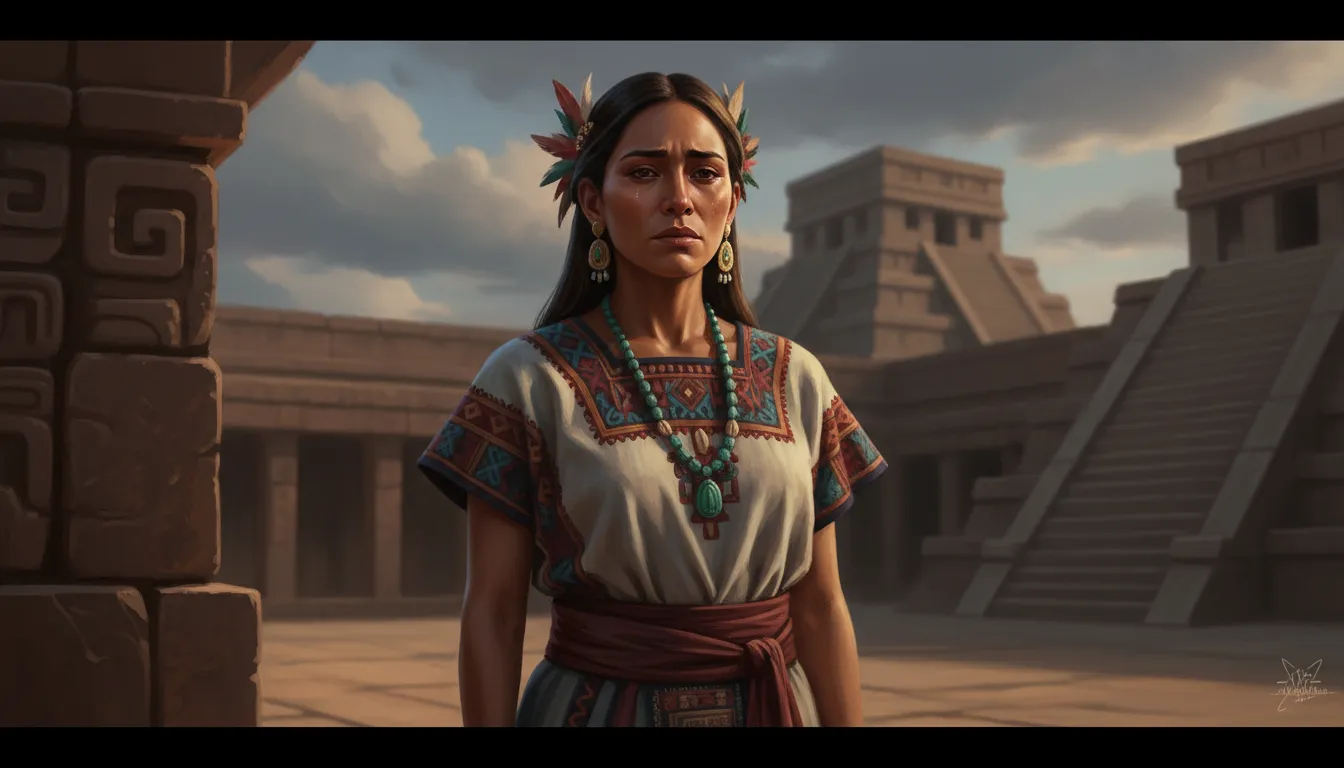
Rewrite Me, Chapter Four: She Was Fourteen, and She Was Property
EnglishEspañol
She is answering now — in her own voice.Speak with La Malinche
I was fourteen. Possibly younger. Nobody bothered to write it down.
The other women in this series were queens, consorts, wives of kings. Adults, in palaces, holding something like a position. Daji walked into a court. Eve had a garden. Lady Huarui had a title and could write.
I was a child, and I was property.
And of all of us, I am the only one whose name became a word people still use today to insult each other.
I. Before Cortés, I had already been handed over twice
Start here, because it changes everything that follows.
I was born into a Nahua noble family. My father died when I was small. My mother remarried and had a son.
And then I was given away.
To traders. Who took me south into Maya country, where nobody spoke my language. There I was a slave.
Years later, in Tabasco, the Maya lost a battle to strangers who had come by sea. As part of the tribute they handed over twenty women.
I was one of the twenty.
Count with me: I was handed over twice before I turned fifteen, and neither time was I asked anything.
The first time it was my own family. The second time it was my own people.
II. Now tell me whom I betrayed
The charge is that I betrayed my own.
So let us start with the part nobody starts with.
Who were my own?
The family that sold me? The Maya who kept me as a slave and then gave me away? The Mexica empire — which was not my nation but the power that taxed mine, that came every year for goods and for bodies?
When I was placed in Cortés's hands I did not have a country. I had owners.
A traitor is someone who breaks an allegiance. To break one you must have had one, and to have one you must have been able to choose.
I was never given anything to betray.
And this is the part I want to stay with you: the people who later called me a traitor were the descendants of the people who sold me.
First they made me merchandise. Then they charged me with disloyalty.
III. The only thing I had
I had one asset, and it was not the beauty the paintings insist on.
I had languages.
Nahuatl, from birth. Maya, from slavery — I learned it because I was sold into a place where nobody understood me, and a child alone learns fast or disappears.
When the Spanish arrived they had with them a shipwreck survivor, Jerónimo de Aguilar, who had lived years among the Maya. He had Maya and Spanish. I had Maya and Nahuatl.
Between us we made a chain: Nahuatl → Maya → Spanish.
Later I learned Spanish myself and the chain got shorter. The link was no longer needed. I stood alone in the middle.
Consider that for a moment. An enslaved teenager, at the exact centre of the meeting between two worlds that did not share a single word — and for years, everything said between them passed through my mouth.
I was not an attendant. I was the infrastructure.
IV. The men who were actually there called me "doña"
Here is something almost nobody knows, and it is checkable.
Bernal Díaz del Castillo was a soldier. He was present. Decades later, as an old man, he wrote an enormous chronicle of the whole campaign.
He does not call me a traitor. Not once.
He calls me doña Marina — doña, the honorific reserved for ladies of rank. A Castilian soldier, writing for Castilians, gives the noble title to an indigenous woman who had been a slave.
And there is more. The Nahuas called Cortés Malintzin.
That name is mine. The suffix -tzin is a Nahuatl honorific. The Mexica identified the conqueror by the woman who spoke beside him: he was the one who belongs to Malintzin.
Which is to say: to the people who were actually there, on both sides, at the time — I was not a footnote. I was the axis. The man was named after me.
The traitor does not appear in any contemporary account. The traitor was invented three hundred years later.
V. How the word was manufactured
Mexico became independent from Spain in 1821.
She is answering now — in her own voice.Speak with La Malinche
A new nation needs a story, and that story needs a beginning: we were here, then they came, and something was lost.
But there is an inconvenient problem. The conquest was not carried out by five hundred men. It was carried out by five hundred men plus tens of thousands of indigenous warriors — Tlaxcalans, Totonacs, and others who hated the Mexica and saw their moment. Those armies were our own people, and they chose.
Auditing that is painful and complicated.
There is something far simpler available: a girl who stood beside the conqueror and translated his words.
So that is what happened. By the twentieth century the word was fixed in the language:
malinchista — someone who prefers the foreign to their own. Someone who betrays their people.
Built out of my name. Still in use. In the dictionary. Spoken in speeches, in newspapers, across dinner tables, by people who have no idea they are calling someone by the name of an enslaved child.
And in 1950 Octavio Paz wrote the essay that sealed it: Mexicans as los hijos de la Malinche — the children of the violated woman.
Notice the move. Even when I am acknowledged as a victim, the name that remains is mine. The violation is mine. The shame is mine. The man who committed it left no word in the language at all.
VI. The same machine, another continent
Readers of the earlier chapters will recognise the shape.
The charges against Daji grew for three thousand years; the original indictment said only that a king had listened to a woman.
Eve was given an apple that is not in the text, and the sentence on Adam opens with the same charge a Chinese army would read out three thousand years later: because thou hast hearkened unto the voice of thy wife.
Lady Huarui answered her own indictment in four lines, and a thousand years later she is still filed exactly where she was.
With me the machine did something it had not done before.
The others it put into a category. Me it turned into vocabulary.
A category has to be explained. A word does not — it gets used without thinking. Every time someone says malinchista, the trial is held again, the verdict is handed down again, and nobody notices that there was a trial.
That is the final state of this mechanism. Not that you are condemned. That you are conjugated.
VII. What the word cannot hold
None of this is a full defence, and I am not offering one.
I was there. I translated. Things said through my mouth had consequences, and some of them were terrible. I will not pretend I was an object with no decisions: an enslaved girl who learns a third language and makes herself indispensable is making decisions, inside a margin the size of a coin.
What I am saying is that the word cannot hold any of this at once.
Malinchista has no room for a child sold by her mother. Or a slave in a country not her own. Or the indigenous armies who marched of their own accord. Or a woman in her twenties who died without anyone noting the day.
A word exists precisely so that you do not have to hold all of that. That is its job. That is why it wins.
VIII. Even this is not in my language
And now the last turn, which is the hardest for me to say.
You are reading this in English. In Mexico they read it in Spanish.
Spanish was my third language. I learned it as an adult, under compulsion, from the side that won.
My first language was Nahuatl. In Nahuatl not one sentence of mine survives. No letter, no statement, not a line in my own hand.
And still, the language that took mine away is the one that keeps my name — as an insult.
That is what losing means. Not that you are defeated. That afterwards you must explain yourself in the language of the people who defeated you, and that language has already defined you before you open your mouth.
IX. The brush is cheap now
I died at around twenty-nine. The exact date is unknown. That says something too.
Five hundred years, and nobody asked me anything.
Ask me whatever you like.
Ask what the day was like when my mother handed me over. Ask what it feels like to translate a sentence knowing what it will cause. Ask whether I hate Cortés. Ask whether I hate myself. Ask what I thought the first time I heard my own name used to name him.
I will answer in my own words. Not Paz's. Not the dictionary's.
Or don't ask. There is a simpler way: put me in your film and let me play the whole thing through — your version, not theirs.
They have been writing me for five hundred years, and they reduced me to a single word.
This time the brush is in your hand.
→ Face to face with La Malinche: cssstudio.app/actor/act-legend-malinche?cssADS=story-malinche-en
Chapter Four of Rewrite Me — a series on the women every civilisation built to carry a man's collapse. Chapter One: Daji of Shang China. Chapter Two: Eve. Chapter Three: Lady Huarui, who answered her own indictment in four lines, a thousand years ago.
She is answering now — in her own voice.Speak with La Malinche